
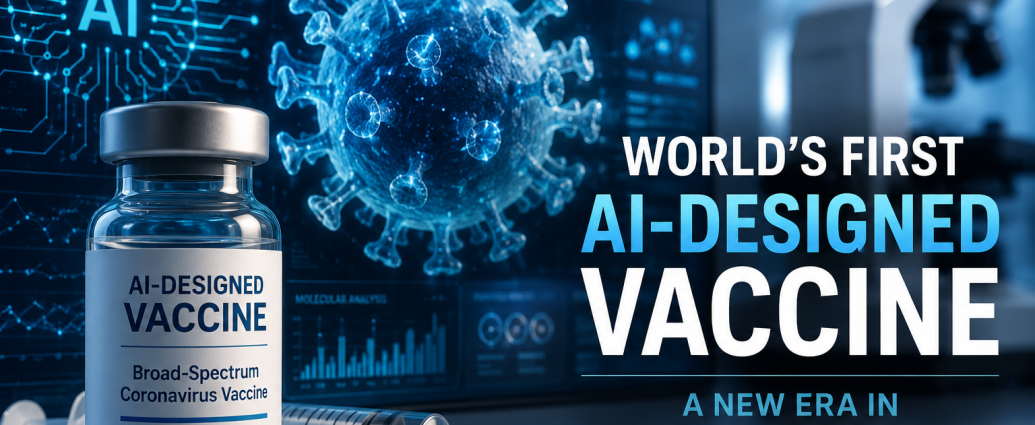
Artificial Intelligence (AI) has achieved another historic milestone. Scientists have announced the world’s first vaccine whose key protective component was designed entirely by artificial intelligence and successfully advanced into human clinical testing. The breakthrough could fundamentally transform how vaccines are developed and may pave the way for broader protection against future pandemics.
A Historic Moment in Medical Science
For more than two centuries, vaccine development has relied heavily on laboratory experimentation, biological modelling, and years of trial-and-error research. Developing a new vaccine often requires a decade or more of scientific investigation, testing, and regulatory review.
Researchers at the University of Cambridge have now demonstrated a radically different approach. Using advanced artificial intelligence systems, scientists designed a novel “super-antigen” capable of targeting multiple coronavirus strains simultaneously rather than focusing on a single known variant. Early human trials have shown promising safety results, marking the first time an AI-designed vaccine component has been tested in people, according to an ITV News report.
The development is being hailed by experts as a potential paradigm shift in vaccinology and pandemic preparedness.
What Makes This Vaccine Different?
Traditional vaccines are typically developed against specific viral strains that have already been identified and studied. As viruses mutate, vaccines often require updates to maintain effectiveness.
The new AI-designed vaccine takes a different approach.
Instead of focusing on one virus variant, machine learning algorithms analysed extensive genetic information from numerous coronavirus strains. The AI identified biological features that remain relatively constant across the coronavirus family and used this information to design a broad-spectrum antigen capable of triggering protective immune responses against multiple related viruses, as detailed in the ITV News coverage of the breakthrough.
In theory, this could provide protection not only against current coronavirus variants but also against future strains that have not yet emerged.
How Artificial Intelligence Designed the Vaccine
Artificial intelligence excels at recognising patterns within vast datasets that would be difficult or impossible for humans to analyse manually.
In vaccine design, AI systems can:
- Analyse millions of genetic sequences rapidly.
- Identify conserved viral regions less likely to mutate.
- Predict which antigens are most likely to trigger effective immune responses.
- Simulate potential vaccine performance before laboratory testing.
- Reduce the time and cost associated with early-stage vaccine development.
Researchers suggest that tasks that previously required years of investigation may eventually be completed within weeks or months using AI-assisted approaches, a possibility explored in a recent analysis by The Times of India.
Why This Matters for Global Health
The COVID-19 pandemic highlighted the devastating consequences of delayed responses to emerging infectious diseases. Although scientists developed effective vaccines at unprecedented speed, millions of lives were lost before vaccination campaigns could be fully implemented.
AI-designed vaccines could significantly improve future outbreak preparedness by enabling scientists to:
1. Respond Faster to Emerging Threats
AI can dramatically shorten the discovery phase of vaccine development, allowing researchers to identify promising vaccine candidates far more rapidly than traditional methods, according to insights highlighted by The Times of India.
2. Create Broad-Spectrum Protection
Instead of targeting individual strains, future vaccines may protect against entire families of viruses, reducing the need for frequent reformulation, as discussed in the ITV News report.
3. Strengthen Pandemic Preparedness
Scientists believe this approach could help prevent pandemics before they begin by generating vaccines against viruses with pandemic potential before major outbreaks occur, a possibility highlighted in the coverage of the Cambridge-led research.
4. Lower Development Costs
AI-powered vaccine discovery could reduce research expenses and make vaccine development more accessible for diseases that currently receive limited investment, a prospect discussed in emerging AI vaccine research literature.
Human Scientists Still Remain Essential
Despite the excitement surrounding AI-designed vaccines, experts emphasise that artificial intelligence is not replacing scientists.
AI serves as a powerful research tool that accelerates discovery, but human expertise remains essential for:
- Experimental validation
- Clinical trial design
- Safety monitoring
- Regulatory approval
- Manufacturing and distribution
Every vaccine candidate must still undergo rigorous laboratory testing and multiple phases of clinical trials before it can be approved for public use, a point emphasised in reporting on the technology.
Beyond COVID-19: The Future of AI Vaccines
The implications extend far beyond coronaviruses.
Researchers are already exploring AI-assisted vaccine development for:
- Influenza
- Ebola virus disease
- HIV
- Polio
- Cancer immunotherapy
- Antimicrobial-resistant infections
Several research programmes worldwide are investing heavily in AI-powered vaccine discovery. The University of Oxford recently launched major initiatives integrating artificial intelligence into vaccine research and cancer vaccine development, while research teams in Asia and Europe are advancing AI-driven personalised cancer vaccines.
Challenges and Questions Ahead
While the breakthrough is remarkable, significant questions remain.
Researchers must still determine:
- Whether the vaccine provides broad protection against multiple coronavirus strains.
- How durable the immune response will be.
- Whether similar AI-designed approaches will work for other pathogens.
- How regulators will evaluate increasingly AI-generated medical products.
Phase II and Phase III clinical trials will be crucial in determining whether the technology fulfils its transformative promise, as noted in the ITV News report on the vaccine.
What This Means for Africa
For Africa, where infectious disease outbreaks continue to pose major public health challenges, AI-driven vaccine development could offer substantial benefits.
Faster vaccine design may improve responses to emerging diseases such as Ebola, Marburg virus disease, Lassa fever, and other epidemic threats. Broad-spectrum vaccines could also reduce dependence on repeated vaccine reformulations and improve preparedness for future outbreaks.
As African countries continue investing in health innovation, artificial intelligence may become an increasingly important tool in strengthening regional vaccine research, manufacturing, and disease surveillance systems.
The Beginning of a New Vaccine Era
The world’s first AI-designed vaccine entering human trials represents more than a technological achievement—it signals a potential transformation in how humanity fights infectious diseases.
If ongoing trials confirm effectiveness, future generations may look back on this moment as the point at which vaccine development transitioned from largely reactive science to predictive, AI-enhanced prevention.
The road to widespread adoption remains long, but one thing is increasingly clear: artificial intelligence is becoming a powerful partner in the global effort to protect human health.